

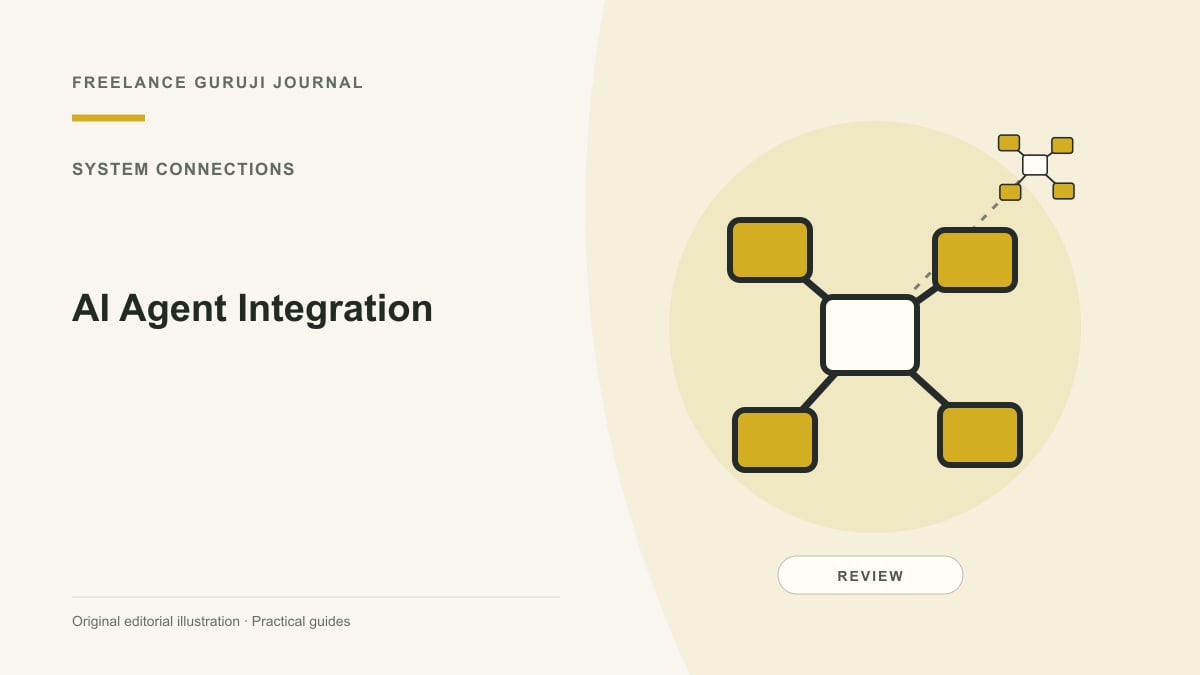
Images are AI-generated editorial illustrations, not documentary photographs or verified product screenshots.
AI agent integration: define integration by the action it enables
AI agent integration connects a system to information or tools so it can participate in a workflow. Reading a project record, drafting a reply and sending that reply are different permissions. Begin with the exact task and the systems involved. Do not grant broad access simply because the integration supports it. The important design question is what the agent may read, propose and change under defined conditions.
Separate read access from write access
A prototype can often begin with approved read-only data and draft outputs. This lets you evaluate usefulness before enabling consequential changes. Identify which fields or documents are necessary and exclude unrelated information. Write permissions should match a specific operation, not a general desire for automation. Keep access revocable and document the account under which actions occur so responsibility remains clear.

Place approval before consequential actions
Payments, external messages, deletions and sensitive record changes may require human review. Define the trigger for approval and what evidence the reviewer sees. A draft step should not silently become a send step. For an illustrative customer-support workflow, the agent might prepare a response while a staff member verifies facts and approves sending. The boundary belongs in the process and tool permissions, not only in a reminder.
Treat retrieved content as data
A webpage, email or document can contain misleading instructions aimed at the agent. Its content should not override the workflow’s trusted rules or expand permissions. Restrict actions to the authorized task and verify suspicious requests through an appropriate channel. Avoid exposing credentials in generated outputs. Testing should include examples where source material asks the system to ignore boundaries, reveal information or perform unrelated actions.
Test failures and duplicate execution
Network interruptions, retries and partial completion are normal operational possibilities. Design actions so repeated execution does not create duplicate invoices, messages or records where practical. Keep audit logs and meaningful error reporting. Test what happens when a required source is missing or approval is denied. A successful demonstration is not enough; the integration also needs a safe response when assumptions fail.

Expand only after a controlled pilot
Use non-sensitive sample data and a narrowly defined workflow. Measure correctness, review burden and recovery behavior, then decide whether additional permissions are justified. NIST’s AI risk-management guidance can support the review, but it does not certify a particular integration. Keep a manual fallback and an owner for ongoing monitoring. Useful agent integration combines capability with explicit boundaries, observable actions and a practical way to stop.
Common questions
Should a pilot begin with every available permission? No. Start with the access needed for a narrow task, often read-only inputs and draft outputs. Expand only when evaluation justifies it. Keep permissions revocable and actions observable so the integration remains controllable when the workflow or risk changes.
Why test repeated execution? Retries can occur after timeouts or partial failures. Without safeguards, the same action may create duplicate messages or records. Test recovery behavior and design an appropriate way to detect or prevent duplicates rather than assuming every successful response corresponds to one execution.
Sources and further reading
Related reading
AI Agents Versus Automations: What Small Teams Need to Know
API Basics for Business Owners Planning an Integration
Automate Client Onboarding with Approval and Recovery Boundaries