

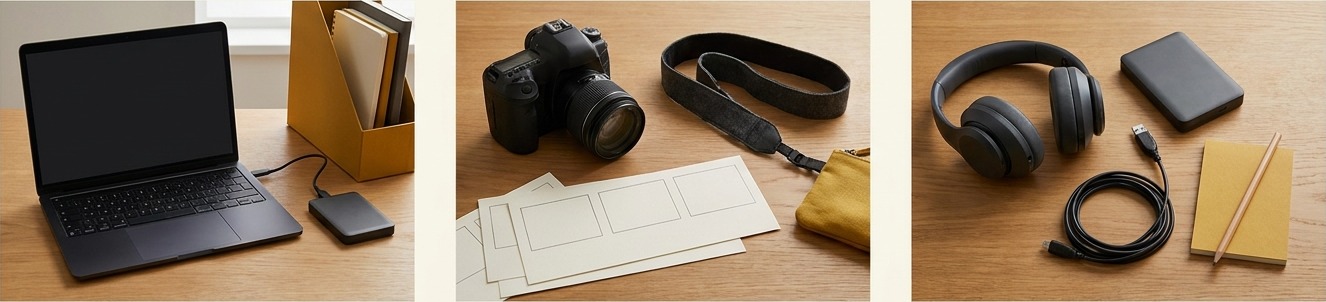
Images are reused AI-generated editorial illustrations, not documentary photographs or verified product screenshots.
An Audacity limiter controls peaks according to its configured behavior. It does not guarantee recovery of audio that clipped during recording, and it is not a universal loudness-compliance button. Review the installed effect and the recipient’s requirements before applying settings copied from another voice, track or tutorial.
Distinguish recorded clipping from output peak control
Check the preserved source and listen for capture distortion. A limiter can change how peaks are handled during processing, but it cannot promise to reconstruct information lost earlier. Adjusting output level after the fact is different from setting an appropriate input level before recording. Diagnose the actual issue first.
Use deliberate settings and a reversible comparison
Review the current limiter documentation for the installed version’s controls and behavior. Keep an original reference and compare representative quiet and loud sections. Excessive processing can change dynamics or create undesirable artifacts. Do not assume that making the waveform denser establishes better intelligibility or a more professional result.
Verify delivery measures and playback separately
Check the actual exported file under the agreed requirements. Peak limits and perceived or measured loudness are related but different concepts. A particular ceiling does not by itself prove every platform or broadcast target is satisfied. Use appropriate measurement and review for the intended delivery, and avoid unsupported numerical guarantees.
A practical checklist
- Inspect the source for capture clipping.
- Separate peak control from restoration claims.
- Review the installed limiter’s documented behavior.
- Compare preserved quiet and loud sections.
- Verify export and actual delivery requirements.
Worked example
Illustrative example: a synthetic narration has occasional strong peaks without a claim that its capture is already damaged. The editor compares reviewed limiter settings with the source and checks the export. A separate clipped test is not labeled repaired merely because its peaks are reduced. Delivery acceptance includes more than the visible waveform height.
Common questions
Can a limiter guarantee restoration of clipped capture? No. Is peak ceiling identical to loudness compliance? No. Should settings be copied unchanged for every recording? No.
What to do next
Keep peak-control intent and delivery checks with the audio notes. A limiter is a processing tool whose outcome needs review, not a promise of repair or universal mastering compliance.
Sources and further reading
Related reading
- Remote Video Editing Jobs: Skills, Samples and Safer Applications
- Can ChatGPT Transcribe Audio? Check the Workflow Before Uploading
Audacity EQ: Adjust Tone Without Confusing It with Noise Removal
Audacity for Voice Over: Record Clean Takes Before Adding Effects